
Building the next generation of African farmers.
Open training in breeding, nutrition, and disease prevention — livestock knowledge as the working answer to hunger and food insecurity across Africa.
Enlighten. Equip. Verify. Grow.
A single pathway from knowledge to livelihood — each step builds on the one before it.
- 01Enlighten
Open knowledge, freely shared
Workshops, on-farm sessions, and digital resources on breeding, nutrition, disease prevention, and farm management. Never gated behind enrollment or payment.
Explore the knowledge hub - 02Equip
The inputs a trained farmer needs
Improved genetics and lab support, vets on standby, vaccination schedules by livestock type, and quality inputs — grass seed, fertile eggs, tilapia fingerlings.
Visit the Farm Store - 03Verify
Genetics and health, documented
The verification of genetics and health records, now applied to livestock raised by farmers we have trained and equipped. Provenance you can check.
See verified livestock - 04Grow
Proof the model works
The investment marketplace — repositioned as evidence, not the headline. Trained farmers, verified animals, real outcomes for the farmer and the partner alike.
Browse the marketplace
Better genetics, without owning the buck.
Artificial insemination puts proven Kalahari, Boer, and Sahel sires into your herd — bucks you could never house, feed, or afford. Our technicians come to the farm on a booked date. And we teach you the part that actually decides whether it works: reading heat, and keeping the record.
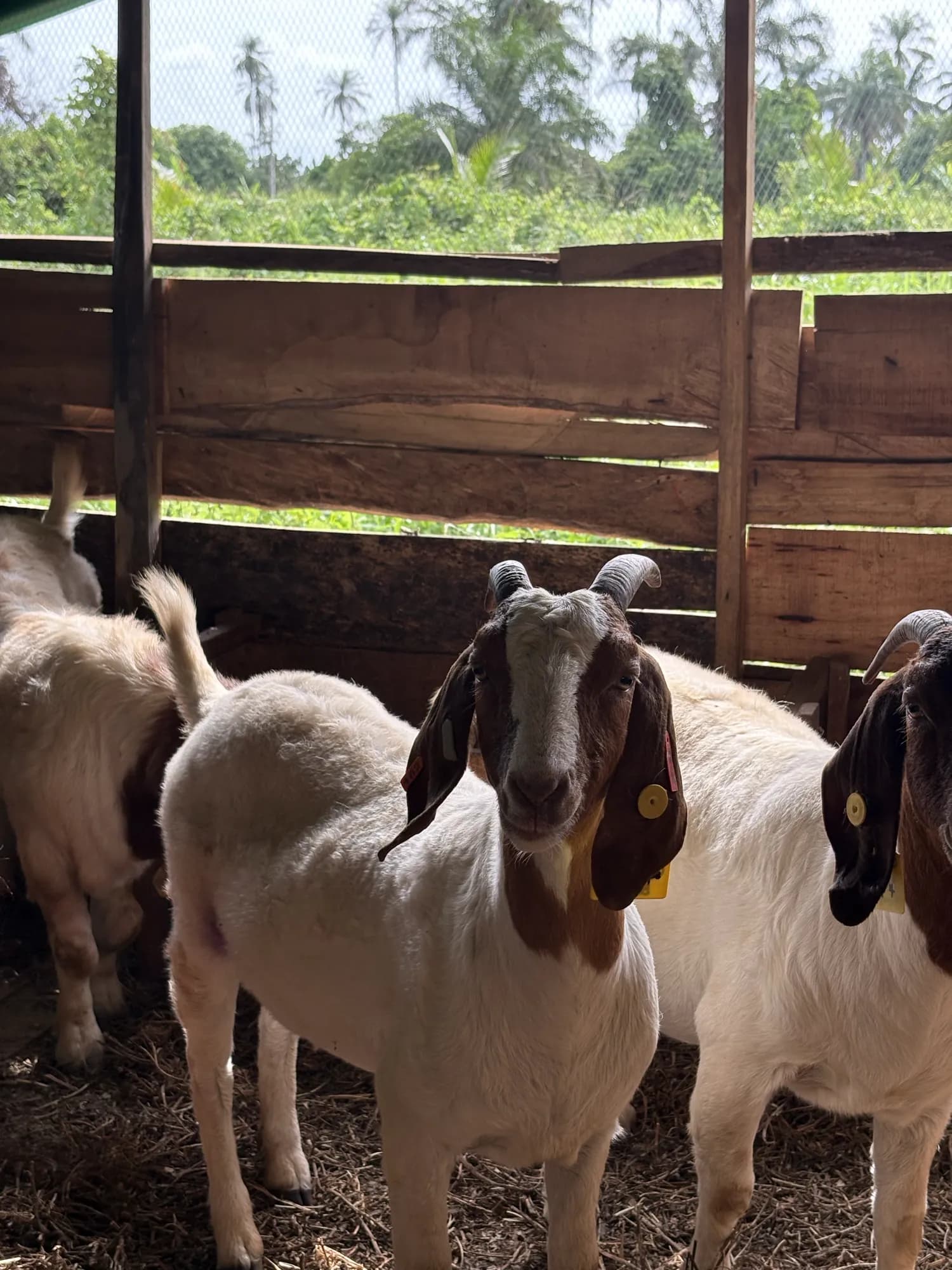
Every straw carries a sire, a breed, and a batch — recorded on the animal it goes into.
- Kalahari, Boer, and Sahel genetics — without a buck to feed, fence, or fear
- No venereal disease walked in on a borrowed buck
- Kids born in a tight window — even-sized, easier to sell
- Semen held in liquid nitrogen at −196 °C until the moment it is used
- Day 0
Synchronise
A progesterone device goes in, and the doe is opened on the breeding record.
- Day 9–11
Device out
Removed alongside a prostaglandin injection. From here, heat is watched morning and evening.
- Day 11–13
Insemination
A straw thawed at the pen and placed on standing heat — roughly 43 to 48 hours after the device comes out.
- Day 30+
Confirmation
Pregnancy checked and the result written onto the herd record. You know at one month, not at five.
Timings follow standard veterinary protocol · Adjusted per animal on the day · Visits by booking only
Insemination on your farm
Book a date and trained technicians travel to you with the flask and the straws. No moving your animals, no borrowing someone else's buck.
Heat detection, taught
Most failed services are missed heats, not bad semen. We teach the signs and the timing until you can call it yourself.
Written to the herd record
Sire, date, technician, and outcome — logged the same way the Herd Health Card logs a vaccination.
Twenty-one days, held steady.
The embryo does the work. Our job is to hold temperature, humidity, turning, and ventilation steady for three weeks and not flinch — then hand you chicks that are dry, counted, and ready to brood.
- Day 0
Set
Eggs go in at 37.5 °C and roughly 45% humidity, turned three to five times a day from here.
- Day 7
Candle
Held to the light. Veins mean an embryo is growing; clear eggs are infertile and come out.
- Day 18
Lockdown
Turning stops so chicks can position themselves. Humidity rises to about 65% so membranes don't dry onto them.
- Day 21
Hatch
They pip, they rest, they come out. Dried off and counted before they go anywhere.
Standard incubation figures · Breeds available on request
Day-old exotic chicks
Exotic stock hatched here and collected at day one. Tell us how many you need and roughly when, and we set eggs to meet your date.
Bring us your eggs
Your fertile eggs, our incubator. You get the chicks at hatch — plus the count of what was set, what candled clear, and what came out.
Wherever you are, there is a next step.
The numbers, plainly stated.
- 93
- Farmers trained
- 01
- Cohorts completed
- 4
- Core disciplines
- 0
- Naira to enroll
First cohort, delivered
and counting
breeding to management
open by design
Raised by trained farmers. Verified.
The marketplace is the evidence, not the pitch — livestock with documented genetics and health records, raised by the farmers we train and equip.
Premium Eggs
Fresh eggs from local farms - chicken, duck, quail, turkey and more. Quality you can trust.
The farmers first. Then the market.
“Before the training I was losing kids every rainy season. Now I follow the vaccination schedule and keep records — my herd has doubled and I sell with confidence.”
“They taught us how to feed properly and prevent bloat. What I learned here I now teach two other families in my village. That is how it spreads.”
“The quality of livestock here is exceptional. Every animal comes with complete documentation — genetics, health records, everything. It transformed how I source breeding stock.”
Farmer attributions are being finalised with Cohort 01.
Visit Our Farm
Come experience our premium livestock firsthand at our facility in Rivers State, Nigeria.
Green Livestock Africa
Odhiogbor road, IGP checkpoint Ele-uma, Mbiama. Rivers State, Nigeria
Get DirectionsStart where you stand. Grow from there.
Learn openly, equip your farm, and join a network raising the standard of livestock farming across Africa. Whether you keep two goats or two hundred.